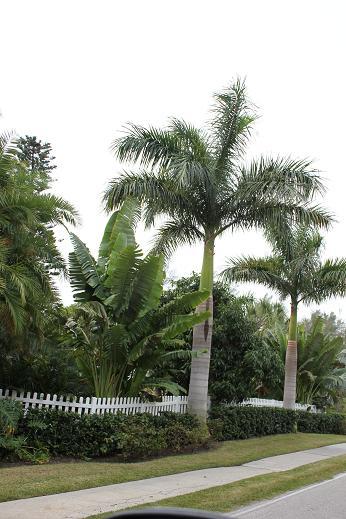
The other week, while sitting with a middle-aged man named Paul, I found myself feeling particularly touched by our conversation. He had just returned from his first vacation in years and was describing the highlights. "I couldn't believe how beautiful the ocean was," he commented. "I've never seen an ocean before, and then to get to see palm trees in person, and to even touch them. It was just amazing."
He began thumbing through a series of photographs on his phone, each displaying an image of a palm tree. Some trees stood right by the beachfront, while others lined a roadside, each seeming to belong to the house just behind it. Some had multiple trunks, and others had one bending, elegant line. Several of his photos pictured the same tree, yet from different angles and perspectives.
While I've seen many palm trees in my life, I've never experienced someone truly appreciating a palm tree. This is what moved me. In all of my vacations to warm, sunny places, it never occurred to me to take such notice of these trees. They've always merely been part of the backdrop and something I've taken for granted.
I have, however, met my own version of Paul's palm tree. When I travelled to Indonesia several years ago, I found my mouth hanging open in awe of the terraced rice paddies that appeared around every bend and corner. I noticed the taxi driver's puzzlement at my repeated requests to have him pull over so that I could take more pictures of these gorgeous works of art. To him, they were as ordinary as a palm tree to a Floridian, or an oak tree to one of us Midwesterners.
When I got back home, I started to put my camera away in the drawer where it's safely kept until the next recital or birthday cake moment. But then I thought twice. It struck me that when I travel to new places, I always pull out my camera to capture novel and interesting images. I take time, even in my own amateurish way, to look at objects straight on and from the side, and I'm often surprised by the beauty and uniqueness revealed through the camera's lens.
I wondered, could this work in reverse?
What if I were to pull out my camera, or maybe even just imagine pulling out my camera, during ordinary and familiar moments in everyday life. Would such a gesture encourage me to start seeing common places and objects as being worthy of a photograph -- worthy in the way that the palm trees were to Paul, and that the Indonesian landscape was to my visiting eyes?
Often, when we're moving quickly from one thing to the next, we don't really see what's around us in the way that we do when we're traveling. It seems this quality of attention is one of the first things we lose when our days fill up with commitments and activities. Just think if we were to arrive at our kitchen each morning in the way we might arrive at a vacation destination, taking in and appreciating the distinctive features of the objects around us. If we were to adopt such an attitude in our everyday life, maybe we'd find ourselves taking photographs of the sunlight coming in through our kitchen window, or the egg yolk rising up in our pan.
It's worth experimenting with this camera-practice, whether we choose to have our lens be literal or metaphoric. When we think as a photographer might, we begin to look at things in a fresh way -- noticing unseen details within everyday objects and maybe even becoming re-enchanted with the familiar world around us.
This way of noticing is something we can do even in the midst of our busy days. It's one of few things we can do that doesn't require extra time... just a shift in how we're paying attention.
As you move through this day, notice what potential snapshots exist. How might you frame them, and what details would you highlight?
Pay attention to the most ordinary and the most extraordinary images your eyes and mind capture today.
Photo credit: Paul Watson
For more "Full Cup, Thirsty Spirit" inspiration, visit: http://www.fullcupthirstyspirit.com/
or visit Karen on Facebook.
For more on mindfulness, click here.
For more by Karen Horneffer-Ginter, Ph.D., click here.
Source: www.huffingtonpost.com


